Cyrillic on the shopfronts, and a boardwalk behind
Soviet Jewish emigration from the 1970s remade the neighbourhood, and the signage, the food shops and the language on the boardwalk followed.
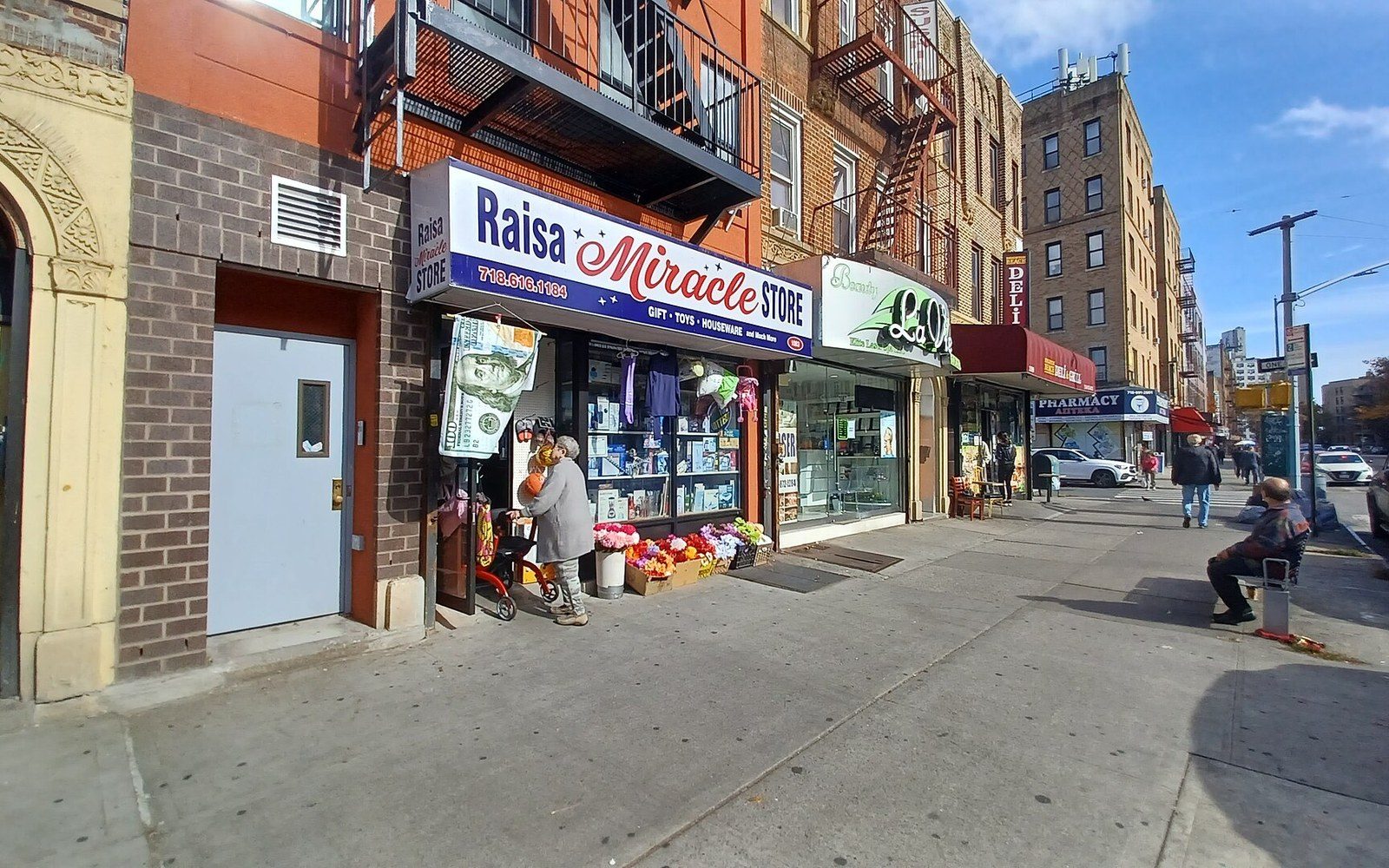
The awnings advertise in Russian first and English second, and have done since the 1970s.Sidewalk on Brighton Beach Avenue, Brooklyn · Wikimedia Commons
The neighbourhood that Soviet Jews rebuilt, one delicatessen at a time
The wave that arrived
Brighton Beach sits at the southernmost edge of Brooklyn, where the land runs out into the Atlantic and the subway surfaces from underground to rattle along the elevated tracks above Brighton Beach Avenue. Before the 1970s it was a faded resort neighbourhood, the kind of place that had been lively in the 1920s and tired by the 1960s: aging bungalows, a boardwalk that had seen better decades, and a population shrinking as younger families moved elsewhere. Then the Soviet Union began, haltingly, to let people go.
The emigration that followed was one of the largest movements of Jewish people in the postwar world. Under pressure from American diplomacy and the Jackson-Vanik Amendment of 1974 — which linked US trade status to Soviet emigration policy ↗ — the Soviet government allowed a trickle, then a flood, of Jewish emigrants to leave. Many came through Vienna and Rome before landing in New York. HIAS, the Hebrew Immigrant Aid Society, helped route new arrivals toward affordable housing. Brighton Beach, with its cheap rents, its ocean air, and its subway connection to Manhattan, was affordable in exactly the right moment. The community landed, and it stayed.
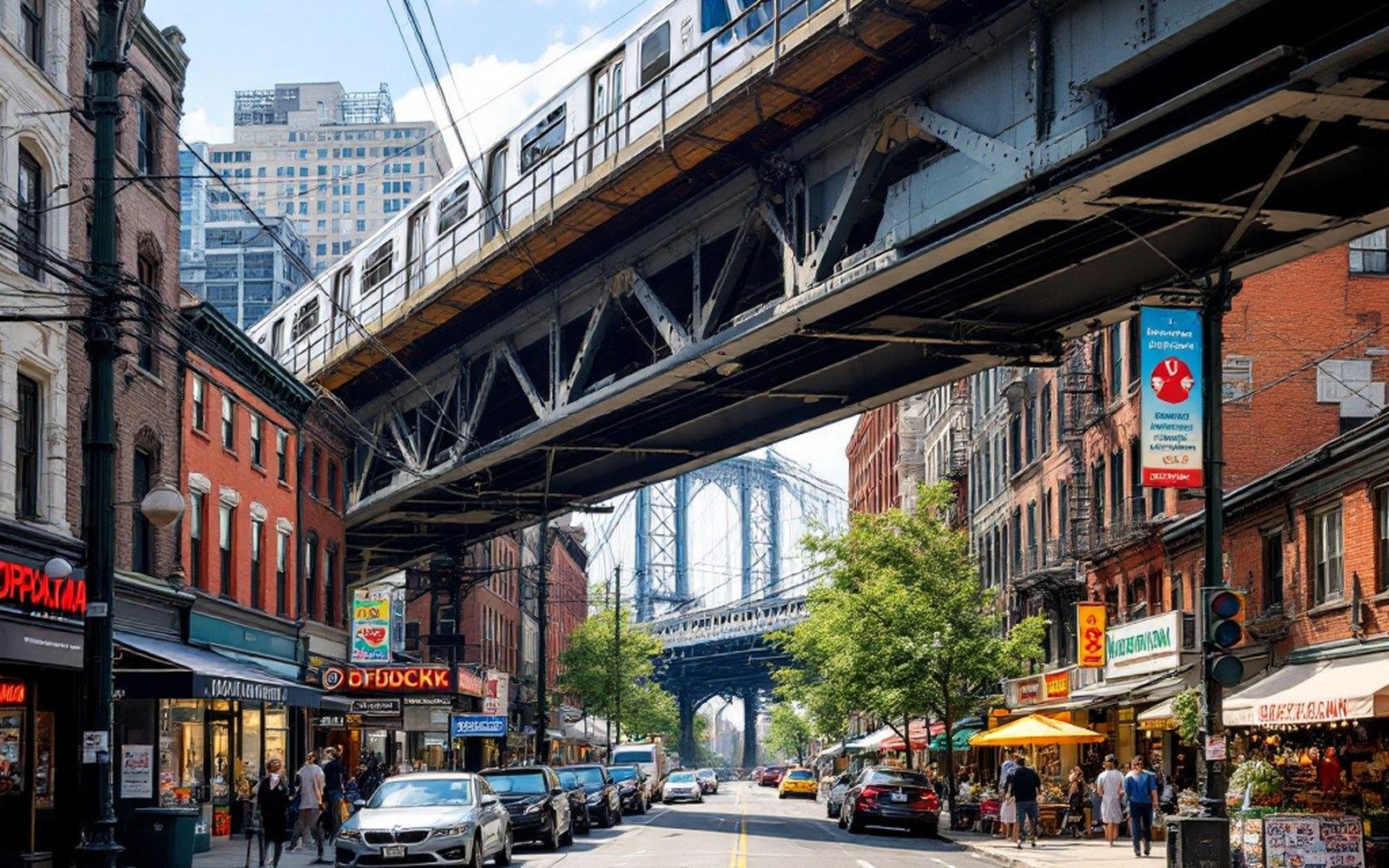
Strung bulbs under the elevated structure, which is the avenue’s ceiling.Brighton Beach — the boulevard under the elevated tracks · Wikimedia Commons
By the early 1980s the neighbourhood had acquired a name that has never left it: Little Odessa, after the Black Sea port city that sent so many of its people here. The parallel was partly geographic — a boardwalk, a beach, a city at the water's edge — and partly demographic. Many of the emigres were not simply Soviet; they were specifically from Odessa, from Kyiv, from the cities of Soviet Ukraine and the Russian-speaking republics. They brought their food, their music, their distrust of authority, and their language, and they printed it on every available surface.
What the avenue became
Walk Brighton Beach Avenue today and you are reading a different alphabet. The storefronts carry Cyrillic lettering above the awnings: the names of grocery chains, restaurants, pharmacies, bakeries. The goods inside — pickled vegetables, smoked fish, dark bread, cured meats, buckwheat, jars of adjika — correspond to a pantry that formed in a different country under a different political system, and that the neighbourhood has reproduced faithfully for fifty years. The smell of fresh dill is structural.
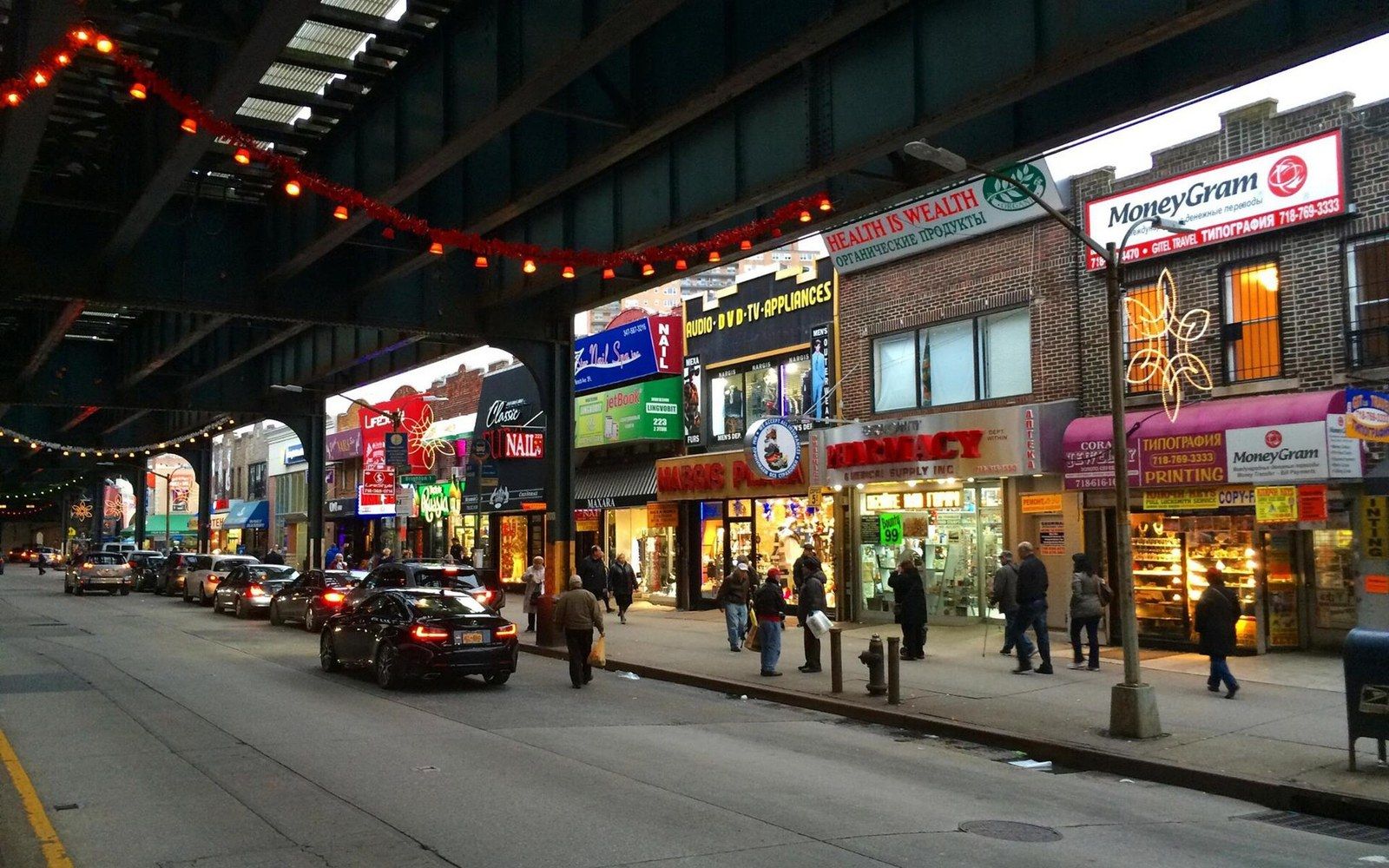
The elevated line runs directly above the avenue, and the relationship between the train and the street below is the same one the el creates everywhere: shade, noise, a certain compression of the space, commerce pushed tight against the columns. Here it shades vendors selling produce from folding tables, and the rumble overhead is so constant that conversations pause and resume around it without comment.
Evening on the avenue: pharmacy, printing and money transfer, all in two alphabets.
The food culture of Brighton Beach is not nostalgic in a museum sense — it is genuinely functional. The stores stock what the community uses. M&I International Foods, which opened on Brighton Beach Avenue in the 1980s, became one of the most recognisable Eastern European grocery operations in the city. Tatiana, the restaurant and nightclub on the boardwalk, has been staging elaborate banquet evenings — the kind of multi-course, music-soaked celebrations that trace directly to Soviet-era restaurant culture — for decades. These are not recreations. They are continuations.
The community that established Brighton Beach was overwhelmingly Ashkenazi Jewish, Russian-speaking, and shaped by decades of Soviet life: state atheism, communal apartments, a cynical relationship with bureaucracy, and a musical culture that ran from classical conservatory training to the Odessa variety-show tradition. That complexity came with the emigres. Brighton Beach has synagogues, but it also has the particular secular Jewishness of people who were Jewish by Soviet designation long before they were Jewish by practice. The neighbourhood contains both.
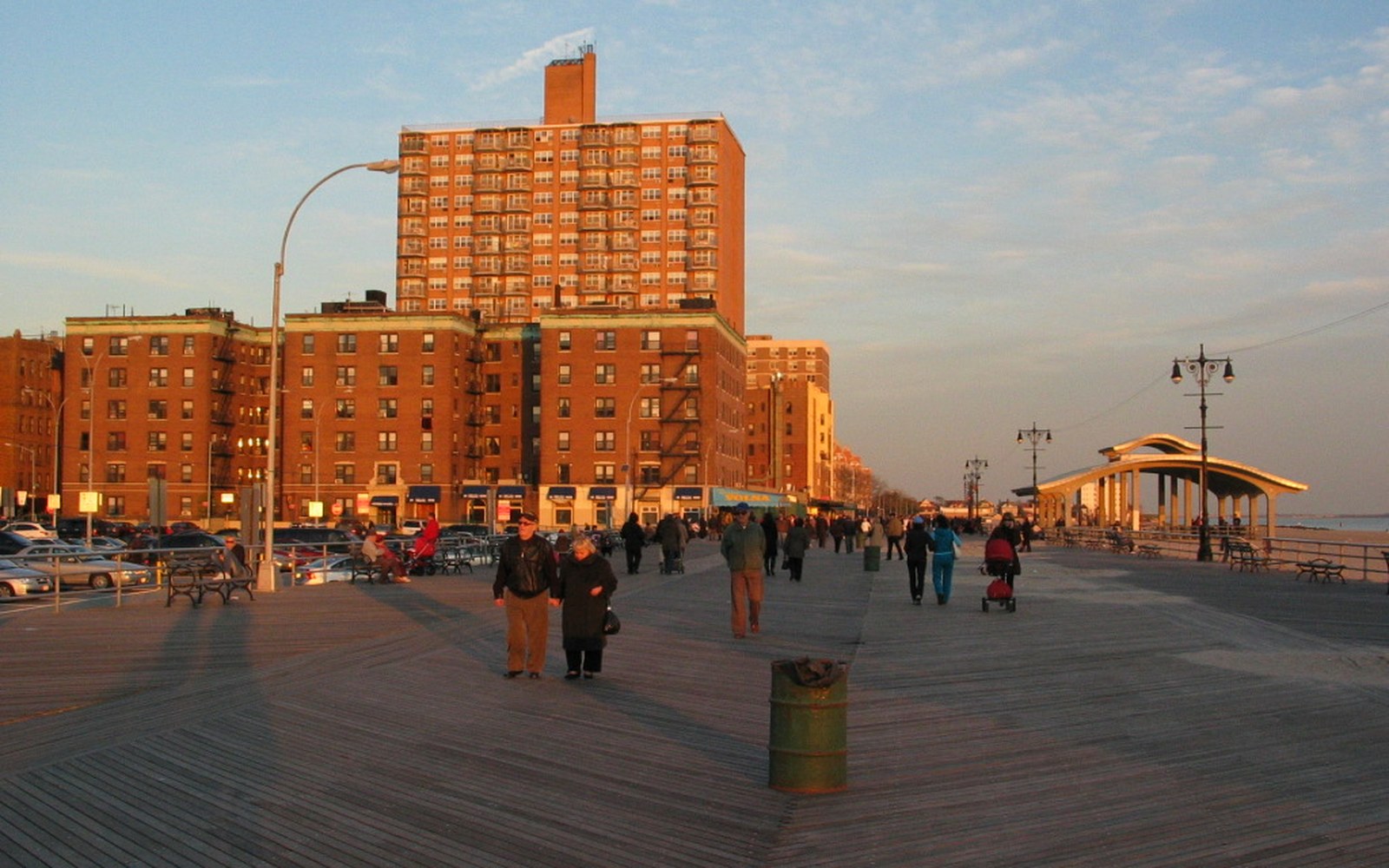
Three blocks south the street ends at the Riegelmann Boardwalk.Brighton Beach, Riegelmann Boardwalk at Brighton 4th Street · Wikimedia Commons
Chronology
1974Jackson-Vanik Amendment links US trade to Soviet emigration rights
Early 1970sfirst significant wave of Soviet Jewish emigres settles Brighton Beach
1980sneighbourhood acquires the name "Little Odessa"; M&I International Foods opens on the avenue
1991Soviet collapse triggers second major emigration wave
Ongoingneighbourhood continues to absorb arrivals from former Soviet states
What the shopfronts carry
Cyrillic signagethe Russian alphabet visible on awnings, windows and menus across Brighton Beach Avenue
Adjikaa spiced condiment from the Caucasus, widely sold in Eastern European groceries here
The elthe elevated subway line on Brighton Beach Avenue, which shades the street and defines its commercial rhythm
The boardwalk and the longer story
The boardwalk at Brighton Beach connects westward to Coney Island and eastward toward Manhattan Beach, running along the Atlantic behind the neighbourhood's residential blocks. It was built as part of the broader development of the Brooklyn shorefront in the early twentieth century, part of the same impulse that made Coney Island a destination for millions of working-class New Yorkers arriving by subway. The beach has always been democratic in that way: free, open, facing south, backed by a wide timber walkway where the whole neighbourhood walks.
On summer weekends the boardwalk fills with older Russian-speaking residents who bring their own chairs and their own food and treat the promenade with the unhurried seriousness of people who have earned their leisure. The scene has been photographed so many times it risks becoming cliché, but the thing itself is not a performance. It is simply how people spend a Sunday when they live two blocks from the Atlantic.
The emigration did not stop in the 1970s and 1980s. A second large wave came after the Soviet Union dissolved in 1991, bringing people from the newly independent states of Ukraine, Russia, Georgia, Uzbekistan, and elsewhere — a movement documented in detail by the YIVO Encyclopedia of Jews in Eastern Europe ↗. The neighbourhood absorbed this wave too, and the community's internal composition shifted: alongside Soviet-era arrivals and their American-raised children came people with direct experience of post-Soviet economic collapse, nationalism, and war. Brighton Beach is not a single Soviet Jewish community frozen at 1979; it is a living neighbourhood that has continued to receive new arrivals and change around them.
What has not changed is the fundamental character of the avenue: Russian-language signage, Eastern European food, a communal outdoor life on the boardwalk, and the sound of a language that is neither the English of the subway announcements above nor the Yiddish of an earlier Jewish Brooklyn. Brighton Beach is the place where the Soviet Union's Jewish emigres arrived and decided, collectively, to remain. The boardwalk is still there. The alphabet is still on the shopfronts. The pickles are excellent.