Sunset Park's Chinese community formed later than Manhattan's and is largely Fujianese, which shows in the shops and on the menus.
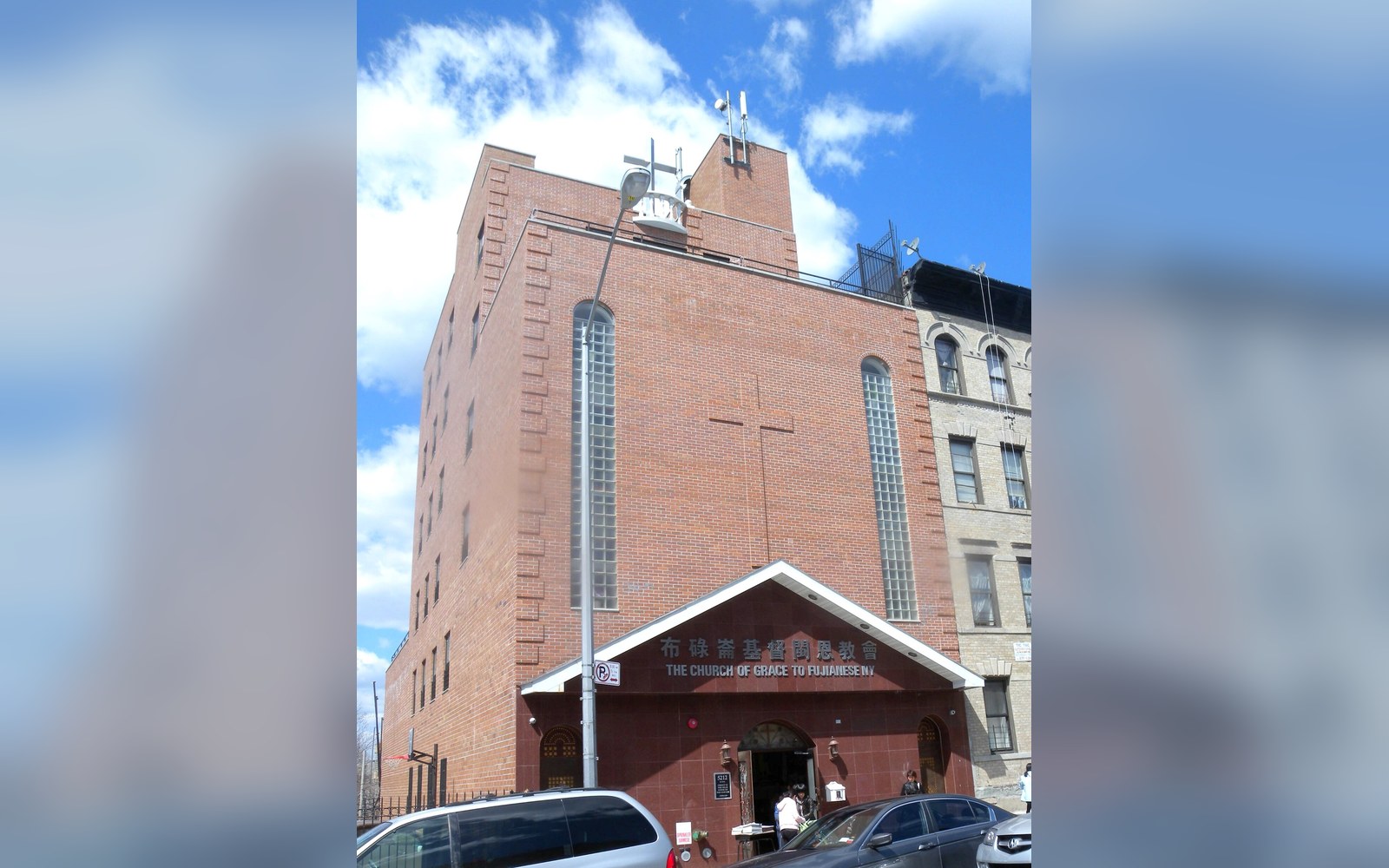
The Church of Grace to Fujianese names the community more precisely than the shopfronts do.Church of Grace to Fujianese, Sixth Avenue at 52nd Street · Wikimedia Commons
The fastest-growing Chinese neighbourhood in the city formed not in Manhattan but along a freight corridor in Brooklyn, and what it serves—and who built it—differs from Mott Street in ways that matter.
How Fujianese Brooklyn came to be
Manhattan's Chinatown traces its deepest roots to the nineteenth century, when Cantonese immigrants, many of them men from Guangdong province who had survived the transcontinental railroad camps, settled around Mott Street and Bayard. By the 1980s that neighbourhood was dense, expensive and ethnically layered—Cantonese, Teochew, Vietnamese—and the blocks around Canal Street were running out of room. A new wave of immigration, this time largely from Fujian province on China's southeastern coast, arrived in the 1980s and 1990s and found Manhattan's Chinatown absorbing but not accommodating. They looked for the next available corridor.
Sunset Park offered the logic of manufacturing districts: cheap loft space that had been vacated as the light-industrial economy contracted, freight infrastructure inherited from the era of Bush Terminal, and elevated transit that connected the neighbourhood to the rest of the borough without demanding a Manhattan commute. The stretch of Eighth Avenue between roughly 42nd and 65th Streets became, through the 1990s, the spine of a new ethnic commercial district. By the time the 2000 Census registered it, the Chinese-born population of Sunset Park had grown large enough to rank the neighbourhood among the city's primary Chinese communities—second only to Flushing in Queens in terms of sheer numbers, and significantly different from both in character.
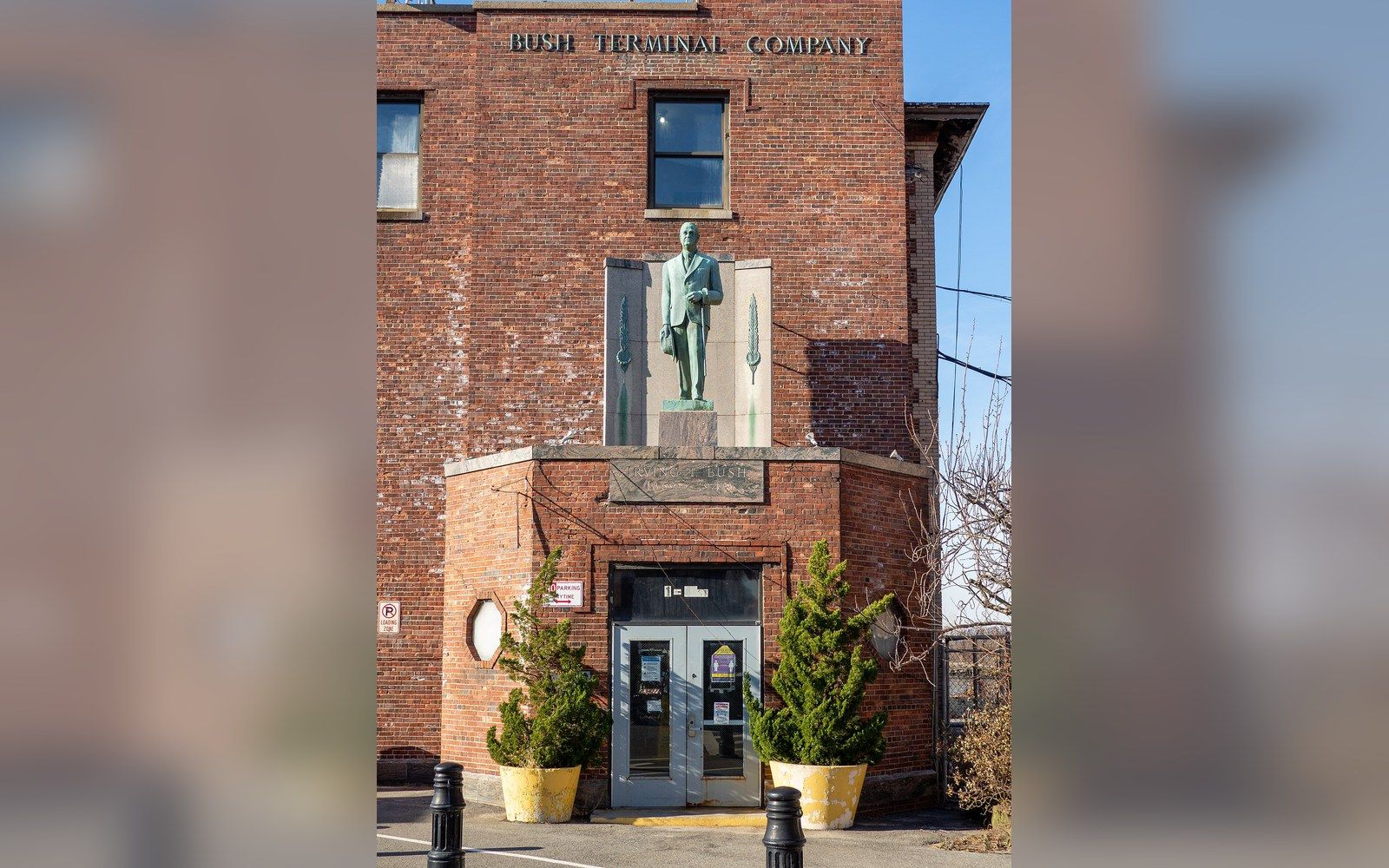
The waterfront that drew the first industrial workforce, downhill from the shops.Bush Terminal Company · Wikimedia Commons
The Fujianese — people from Fujian, a coastal province that faces Taiwan across a narrow strait — had their own chain migration logic. Once a few families established themselves and sent word back, others followed, often from the same villages or county networks. Fujian has a strong culture of sojourning: men and women leave, earn abroad, and remit. This pattern had already shaped Fujianese communities in Europe, Southeast Asia and Japan before it turned strongly toward the United States. The migrants who arrived in New York were often undocumented, arriving through networks that charged enormous passage fees, and they arrived needing work, not time. Sunset Park's garment factories, restaurants and grocery supply chains could absorb them. The neighbourhood absorbed them in turn.
What Eighth Avenue says
The street-level evidence on Eighth Avenue is specific, and specificity is the point. The signage is simplified Chinese where Manhattan's Chinatown still often uses traditional characters—a quiet marker of a mainland origin. The restaurants cluster toward Fujianese regional cooking: dishes built around light broths, rice congee, sweet-potato starch noodles and the use of red wine lees as both seasoning and colour. Fish balls made from fresh rather than processed fish. Clam soups that reflect a fishing-coast palate. These things are not unavailable in Manhattan's Chinatown, but they are not the dominant register there the way they are here.
The bakeries sell pineapple buns and cocktail buns that are broadly Cantonese in form, because food culture travels in layers and the Cantonese baking tradition got there first, but the savoury snacks alongside them—fried dough sticks, turnip cakes, sesame-paste filled pastries—reflect a longer stretch of the Chinese coast. The grocery stores stock produce that tracks what Fujianese cooking actually requires: taro in the large, starchy varieties used in savory preparations, dried mushrooms sold by the pound from open bins, fresh tofu in textures not stocked in the median American supermarket.
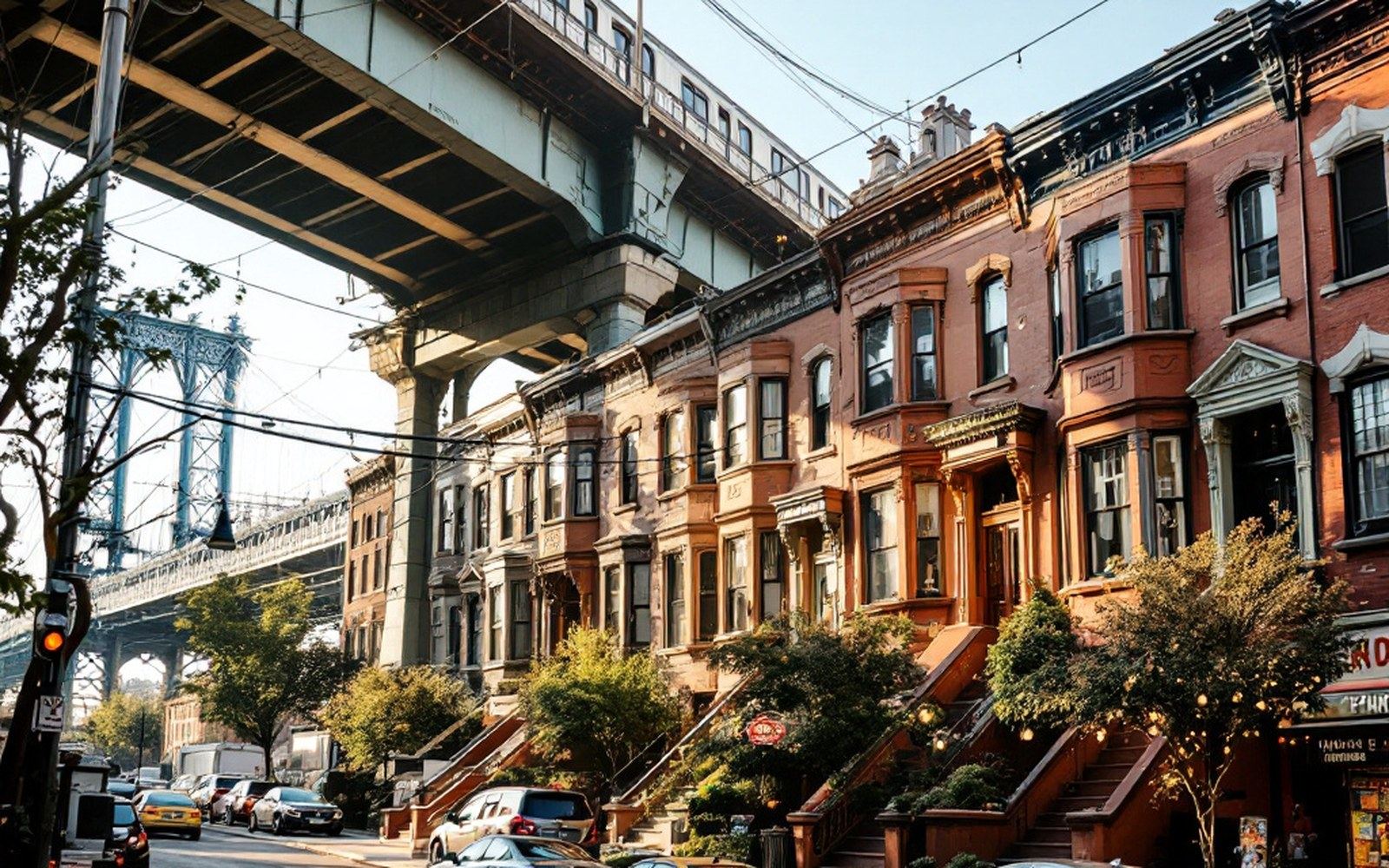
The housing above the storefronts is ordinary nineteenth-century Brooklyn.
Beyond food, the commercial strip functions as the neighbourhood's administrative and connective tissue. Travel agencies, immigration-document preparers, wire-transfer shops and phone-plan vendors cluster on the same blocks as the restaurants and grocery wholesalers. Clan and county associations—the organisational form that Chinese migrant communities have used since the nineteenth century, grouping people by shared surname or home county—operate offices on upper floors. These are not nostalgic institutions; they are functional ones, providing dispute resolution, employment networks and a social safety net for communities that have had good reason to stay outside formal systems.
Settlement chronology
Pre-1980sSunset Park is predominantly Scandinavian, Irish, then Puerto Rican and Mexican/Central American working-class
1980sFirst Fujianese arrivals, drawn by vacated industrial space and elevated transit
1990sCommunity consolidates along Eighth Avenue; commercial strip formalises
2000 CensusChinese-born population large enough to rank Sunset Park as a primary Chinese community in New York City
What Fujianese cooking looks like on the menu
Red wine leesfermented rice-wine residue used as seasoning and colouring, distinctive to Fujian cooking
Fish ball soupfresh-fish-paste balls in light broth, distinct from processed Cantonese variants
Sweet-potato starch noodlestranslucent, chewy, different from both egg and rice noodles
Rice congeethin, savoury, often served with preserved vegetables or pork
How the street works
Clan and county associationsmutual-aid organisations grouping members by surname or home county; offices on upper floors of commercial blocks
Wire-transfer shops and travel agenciespart of the remittance infrastructure connecting the community to Fujian
Wholesale food distributionoperates behind the retail front; supplies restaurants across the metropolitan area
The neighbourhood behind the avenue
Eighth Avenue is Sunset Park's commercial address, but the residential neighbourhood behind it is denser and quieter and less immediately legible to an outsider. The housing stock is predominantly late-nineteenth and early-twentieth-century rowhouses — brownstone and brick, with stoops fronting narrow sidewalks—built for Scandinavian and Irish workers when Sunset Park was an industrial-waterfront district. By the time the Fujianese community arrived in force, these blocks had cycled through successive tenancies: Puerto Rican families who had come north in the postwar decades; Mexican and Central American immigrants who arrived from the 1970s onward. The Chinese community is not the whole of Sunset Park and never tried to be; the neighbourhood remains genuinely mixed in ways that its southern and northern anchors make visible—Latino bodegas give way to Chinese herb shops give way to Latino bodegas again as you move across the grid.
The park itself, high on the ridge with its long views across the harbour toward the Statue of Liberty and the Verrazano-Narrows Bridge, is genuinely shared. Weekend afternoons fill it with families from across the neighbourhood's full ethnic range. The view from the park explains something about the site: the Manhattan skyline is visible to the north, and the industrial waterfront that made this edge of Brooklyn legible as a working-class place stretches in both directions. Sunset Park the park is on high ground precisely because the neighbourhood grew up around freight corridors and piers on the lower ground, and the ridge was cheaper, steeper and further from the smell of the waterfront.
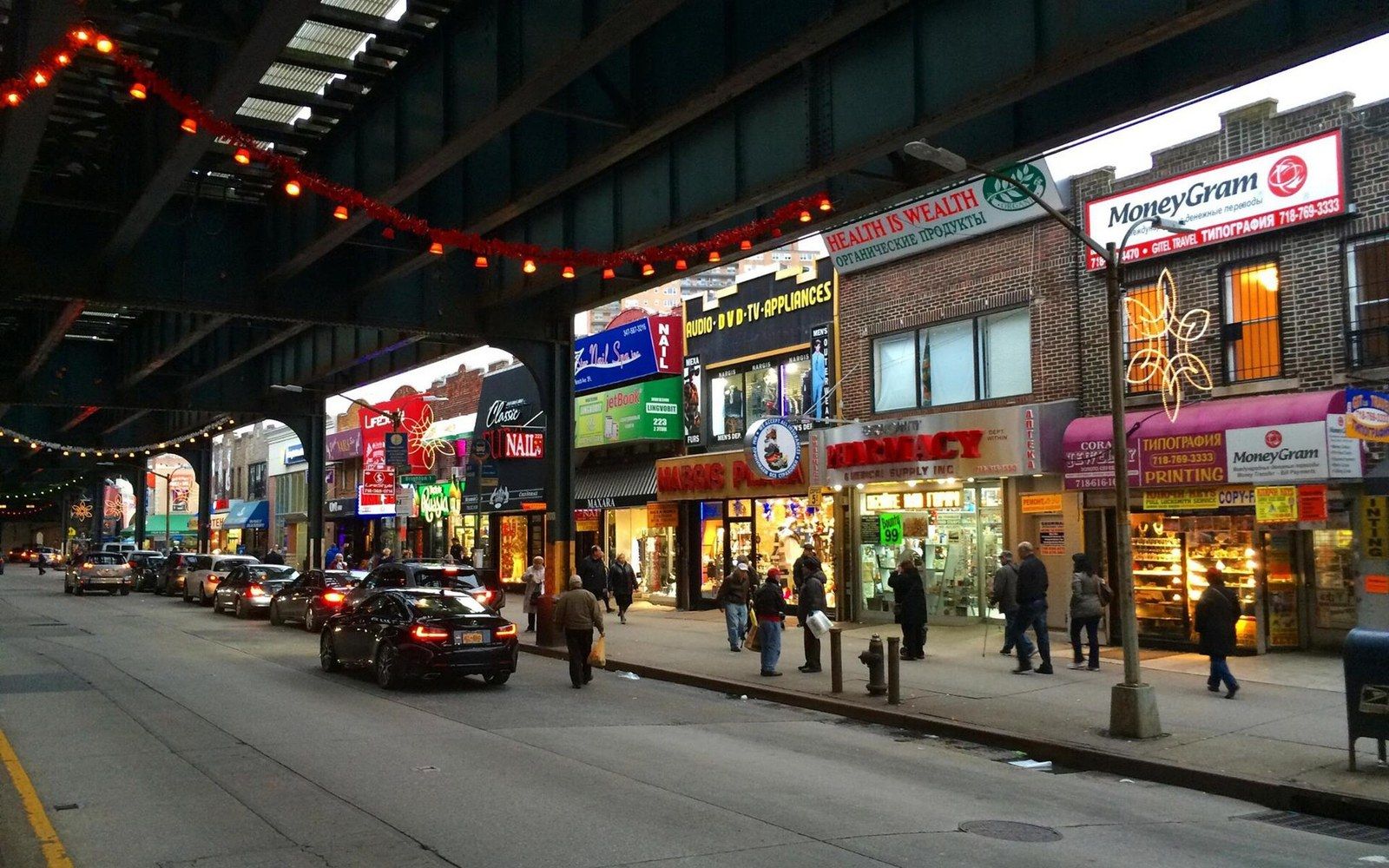
An elevated line over a commercial avenue — the arrangement Sunset Park shares with Brighton Beach.Brighton Beach — the boulevard under the elevated tracks · Wikimedia Commons
The later arrivals and what they built
The Fujianese community in Sunset Park now represents several decades of settlement, and its internal structure has changed as the community has aged and as immigration from Fujian has itself shifted. A first generation that arrived in the 1980s and 1990s is now older, and their children and grandchildren ↗ have spread out through the borough and beyond. The commercial district continues to serve new arrivals, but it also serves an established community whose relationship to the neighbourhood is no longer purely instrumental.
The garment industry that initially provided so much of the neighbourhood's employment has largely contracted. Restaurants remain, and they remain the sector through which Sunset Park's Chinese community is most visible to outsiders. But the wholesale food-distribution businesses that operate in the streets around Eighth Avenue—the ones supplying restaurants across the metropolitan area—are perhaps more economically significant, and they represent a kind of infrastructure building that the community has done steadily and with relatively little outside attention. Fujian province itself has continued to urbanize and develop rapidly; the Fujianese diaspora maintains connections back that have grown more complex as the origin shifts from poverty to something more varied.
Sunset Park's Chinatown did not begin with a plan. It began with a freight corridor that had room, with transit that ran early and late, and with a community that needed a place to work and then a place to stay. The avenue built itself around those facts, and it has remained more working than scenic, more functional than curated—which is, in context, exactly the point.