After her husband was disabled by caisson disease she carried the engineering to the site, dealt with the trustees, and was first across when it opened.
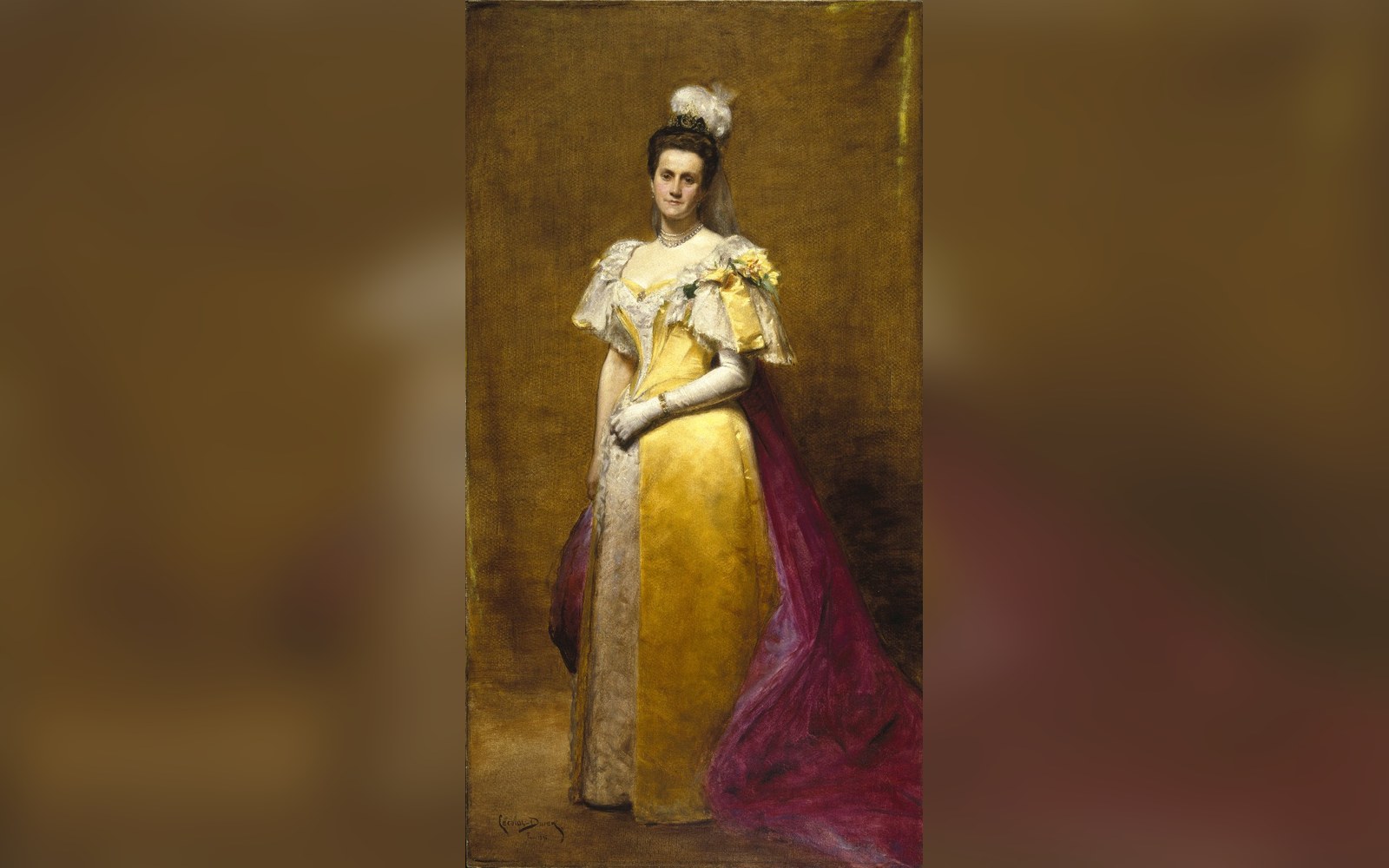
Carolus-Duran painted her in 1896, thirteen years after she crossed the bridge first.Portrait of Emily Warren Roebling, Carolus-Duran · Brooklyn Museum, via Wikimedia Commons
The chief engineer's wife who became the chief engineer
When Washington Roebling was carried out of the caisson beneath the East River in the early 1870s, the damage was permanent. Caisson disease — decompression sickness, not yet understood — had wrecked his nervous system. He could still think. He could still see the towers from his bedroom window at 110 Columbia Heights, the house on the Brooklyn heights where he would spend the next eleven years directing the bridge's construction without ever setting foot on it. What he could not do was cross the water, face the trustees, manage the contractors, or be present on the deck. For all of that, he had Emily.
Emily Warren Roebling had married Washington in 1865, the year the Civil War ended, and the bridge had been central to their lives almost from the start. Her father-in-law, John A. Roebling, was the engineer who conceived the crossing, who had built the Niagara and Cincinnati suspension bridges and who had made his fortune on wire rope. He died in 1869 from a tetanus infection after his foot was crushed by a ferry at the Fulton Ferry landing, before the foundations were dug. Washington inherited the project. Emily inherited, through circumstance rather than plan, the decade that followed.
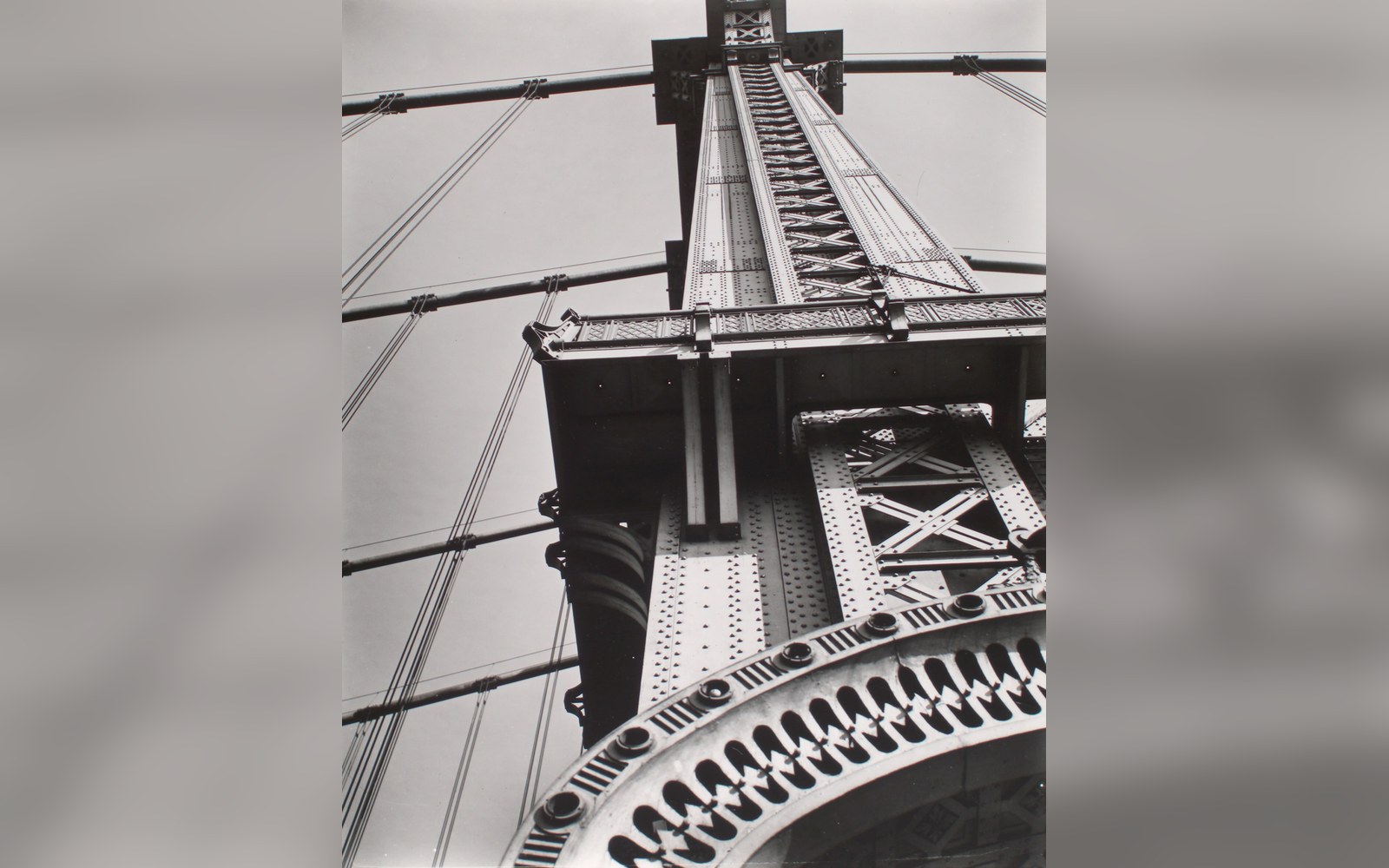
This is the view Washington Roebling worked from, at a distance, through a telescope.Manhattan Bridge, from Bowery and Canal Street (NYPL b13668355) · Wikimedia Commons
What she actually did
The standard account of Emily Roebling has a tendency toward the decorative: the devoted wife who carried her husband's messages, the loyal intermediary who smoothed things over at the trustees' meetings. The record does not support that reading. Emily undertook a systematic self-education in engineering ↗ — higher mathematics, the properties of wire cable, bridge specifications, the mechanics of catenary and load distribution — that gave her the technical authority to represent the project in a room full of engineers and not be tested out of it. This was not the work of months. It was the labour of years.
She held the role that would today be called site manager, client liaison, and technical representative all at once. She appeared before the board of trustees when the project's future was in question and when critics — there were several, and they were credentialed — argued that Washington Roebling was too incapacitated to continue as chief engineer and should be replaced. Her intervention at those meetings is documented. The bridge's historian David McCullough, in his 1972 account of the construction, drew on the correspondence and reports of the period to establish that Washington Roebling directed strategy from Columbia Heights while Emily was the effective operational intelligence at the Brooklyn end. The trustees knew it. The contractors knew it.
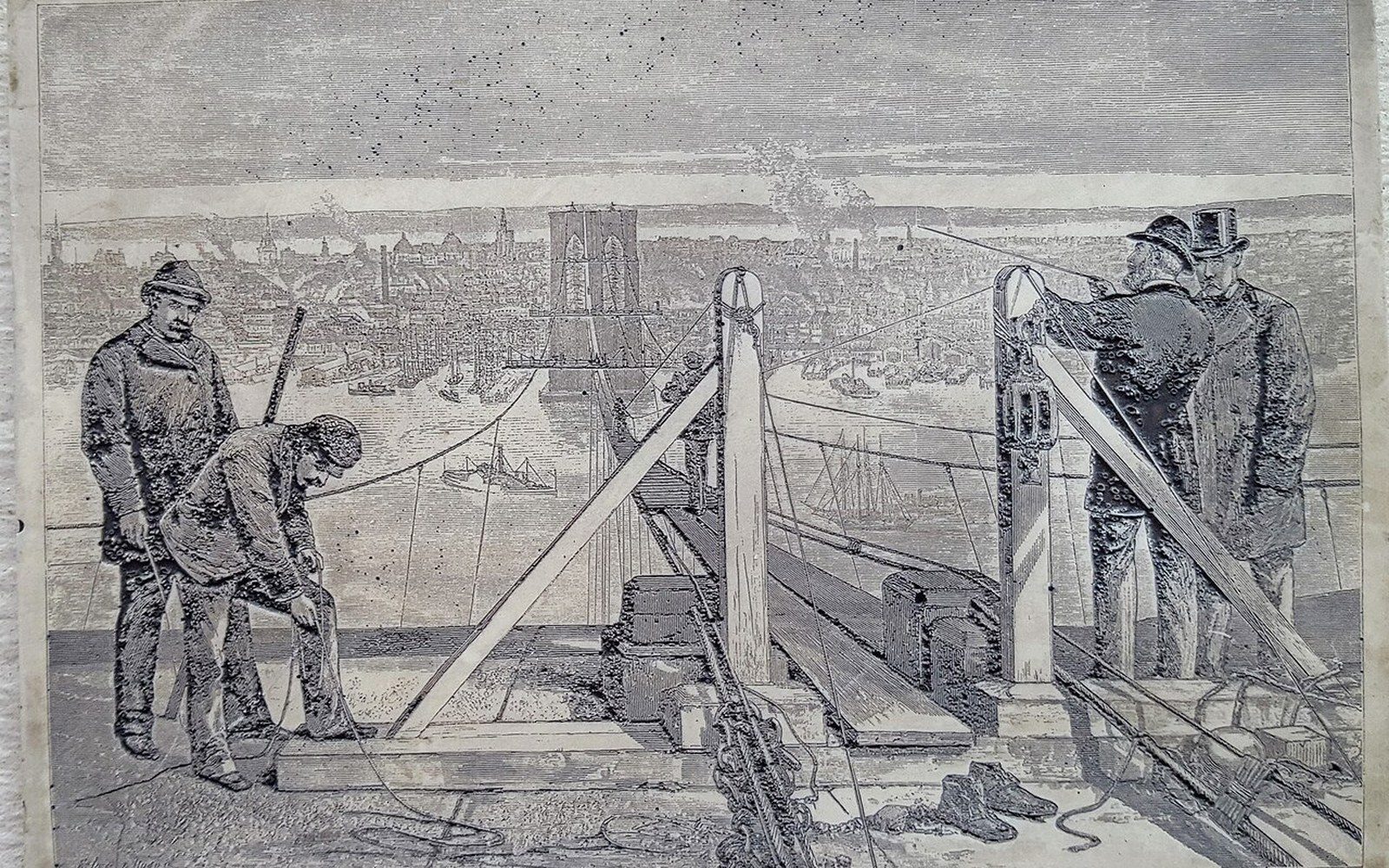
The site she rode to daily while her husband stayed at 110 Columbia Heights.View from Tower to Tower, 1877 · Wikimedia Commons
Her daily work involved riding to the site, consulting with the foremen and engineers on the ground, relaying Washington's written instructions and her own judgments about what was needed, and returning with information he would use to produce the next set of directions. Washington, equipped with a telescope, watched from the window. The cables went up, the anchorages were sunk, the roadway was strung between the towers, all of it managed through this strange and functional division: strategic direction immobile at the window, operational command mobile across the river.
Chronology
1865Emily Warren marries Washington Roebling
1869John A. Roebling dies; Washington inherits the project
Early 1870sWashington disabled by caisson disease; Emily begins managing the project
1870s–early 1880sRepeated trustee challenges to Washington's tenure; Emily defends his role
24 May 1883Brooklyn Bridge opens; Emily crosses first, in a carriage
1903Emily Warren Roebling dies
1926Washington Roebling dies
Her technical education — what she learned
Higher mathematics and cable mechanics
Catenary load distribution and suspension bridge specifications
Wire properties and construction sequencing
How to read and represent engineering drawings in trustee meetings
The trustees, the attacks, and the eleven-year argument
The New York Bridge Company's trustees were not uniformly sympathetic. There were recurring efforts, particularly in the mid-1870s and again in the early 1880s, to remove Washington Roebling on grounds of incapacity and install a new chief engineer. The engineer most seriously proposed as a replacement was William Hildenbrand, the assistant engineer. The campaign against Washington was sometimes personal, sometimes institutional, occasionally both. Emily answered it. She wrote letters — direct, technical, measured — to board members. She appeared in person. The correspondence that survives shows a woman who understood that her husband's position was her project's continuity, and who defended both without sentimentality.
The trustees ultimately retained Washington Roebling, and the bridge was completed under his name and hers. The distinction matters because for most of the twentieth century only his name was commonly attached to it. The Brooklyn Bridge ↗, which opened on 24 May 1883 and which remains one of the longest-surviving examples of a wire-cable suspension bridge in continuous use, was built by a collaboration that the historical record only recently began to credit with the accuracy it deserves.
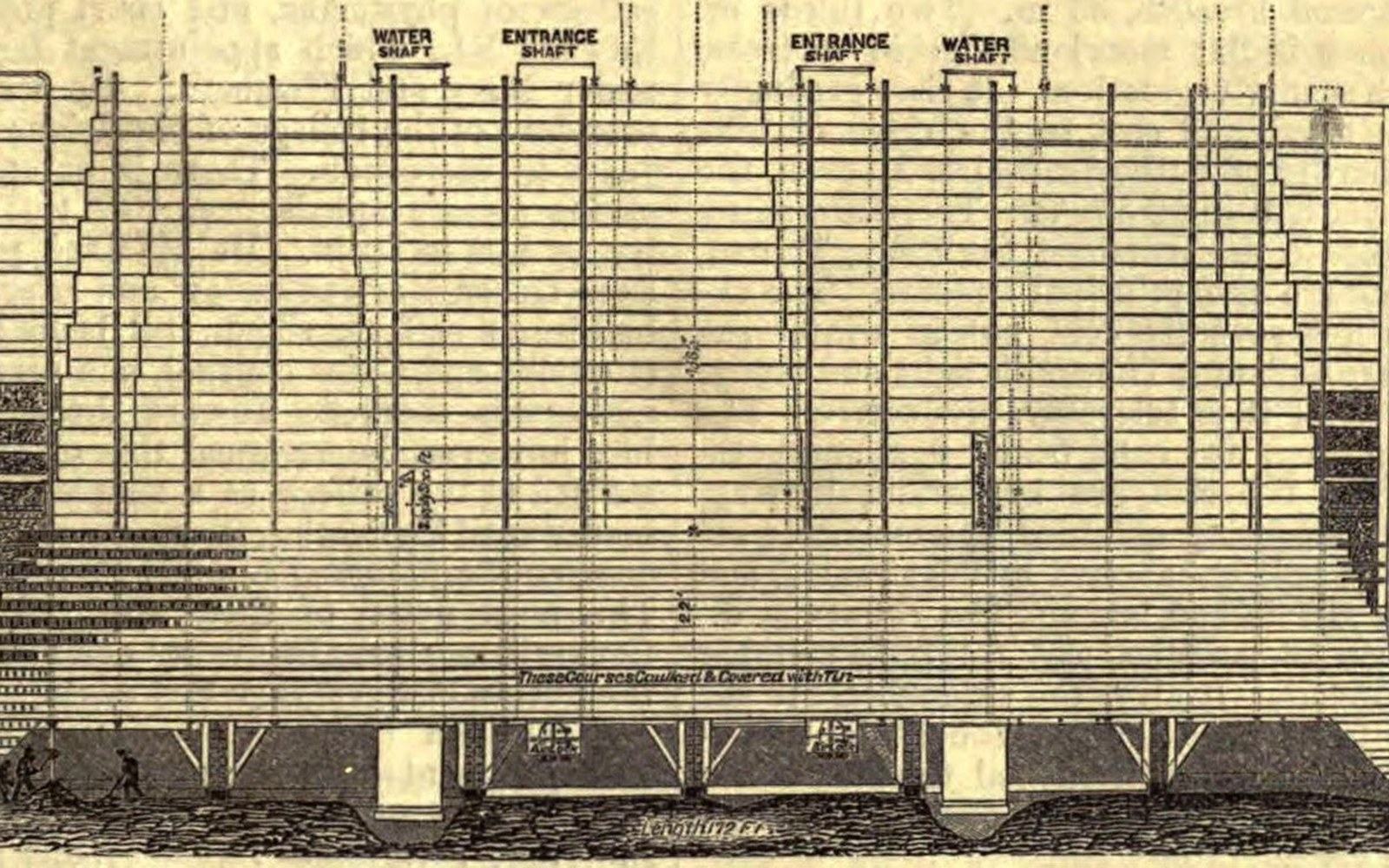
The chamber that ended his working life, drawn in section for a period encyclopaedia.AmCyc Caisson — caisson of the East River Bridge · Wikimedia Commons
First across
The ceremony on opening day was held on the New York side. President Chester A. Arthur was there. The Governor of New York was there. There were speeches. Then the procession walked the bridge. Emily Roebling crossed first, in a carriage, carrying a rooster — a symbol of victory that was either her own choice or the family's, depending on the source. Whatever the rooster signified, the choice of who went first was not accidental. Washington could not be there. Emily was the chief engineer's representative in the most literal sense: she was the person who had built the bridge, functionally, and she crossed it before any of the politicians and dignitaries who had only overseen or obstructed it.
Washington watched from Columbia Heights.
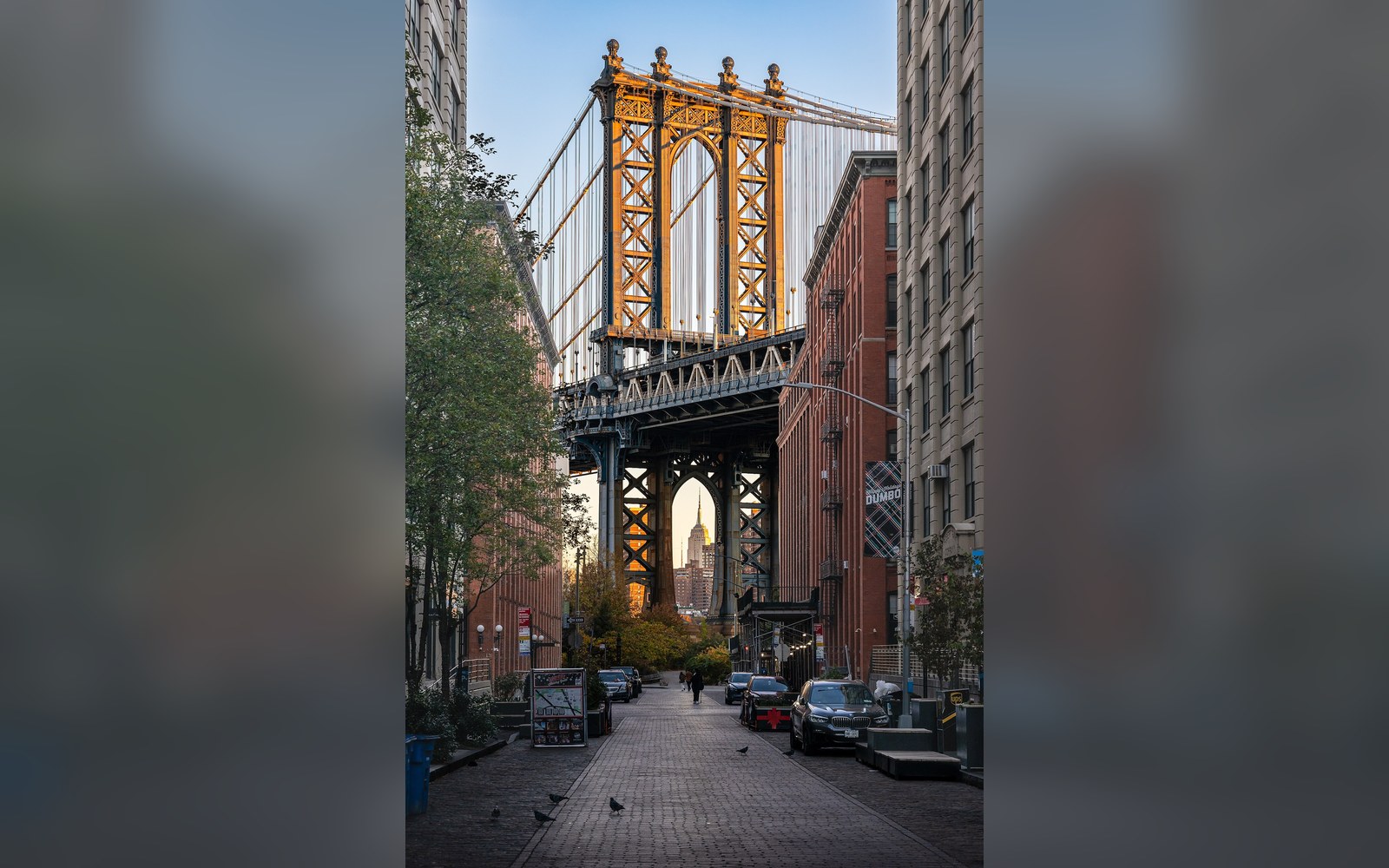
The streets that filled in under the Brooklyn anchorage once the crossing opened.Manhattan Bridge from DUMBO, 2024 · Wikimedia Commons
What followed, and why it matters here
The neighbourhood that grew directly beneath the Brooklyn anchorage — DUMBO, Down Under the Manhattan Bridge Overpass, though the Manhattan Bridge came later — was shaped in part by the bridge's presence. The Roebling wire works were not located there, but the industrial waterfront that surrounded the anchorage from the 1880s onward carried the bridge's logic: heavy materials, river access, warehousing, the infrastructure of a crossing that moved thousands of people a day before the subway existed. Emily Roebling did not plan DUMBO. She helped build the structure that made it a neighbourhood.
After the bridge opened, Emily did not vanish from public life. She studied law at the Woman's Law Class at New York University, took an interest in women's rights and club organization, and wrote and spoke on topics that included the position of women in public affairs. She died in 1903, twenty-three years before her husband, who lived until 1926. Her contributions to the bridge's construction were acknowledged on a plaque installed at the Brooklyn anchorage, though the wording and timing of that recognition came slowly.
Walt Whitman, who had crossed the East River by ferry for decades and who wrote about Brooklyn's waterfront with the devotion of a local, did not live to see the bridge fully used — he died in 1892 — but he had written about the crossing and the city it would bind together. The bridge he celebrated was a collective achievement. The person most responsible for its daily execution, for the eleven years between the caisson and the carriage, was Emily Warren Roebling, and the bridge at the edge of DUMBO is hers as much as anyone's name on the plans.